
Agentic AI in 2026: The Complete Enterprise Guide to Autonomous AI Agents
Agentic AI in 2026 refers to autonomous artificial intelligence systems that independently plan, reason across multiple steps, use tools, and execute complex tasks — without requiring human input at every stage. Unlike generative AI that simply responds to prompts, agentic AI systems pursue goals, adapt to dynamic environments, integrate with enterprise software, and act on behalf of users or organizations at scale. In 2026, agentic AI is deployed across healthcare, finance, software engineering, and supply chain operations — fundamentally reshaping how knowledge work gets done.
1. What Is Agentic AI? Meaning & Core Architecture
The term agentic AI meaning has rapidly moved from academic AI labs into enterprise boardrooms. At its core, an agentic AI system is one that operates with a degree of autonomy — it doesn't just answer a question, it takes action to achieve an objective.
Where a conversational AI waits for your next message, an agentic AI system might receive a single high-level directive — "analyze our Q1 sales data, identify anomalies, draft a board report, and schedule a review meeting" — and autonomously complete every step, using integrated tools, APIs, and data sources along the way.
Agentic AI combines three capabilities: goal-directed planning, tool use (web search, code execution, API calls), and iterative reasoning — allowing it to decompose complex tasks and execute them sequentially or in parallel without human handholding.
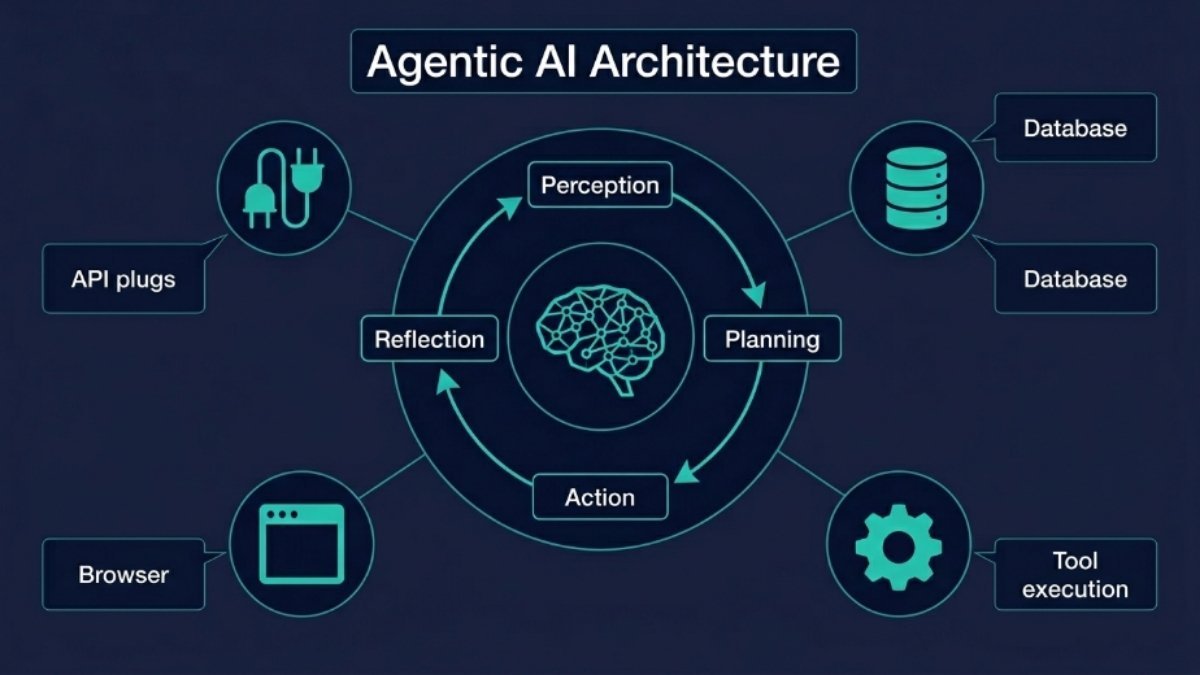
The architecture behind most agentic systems in 2026 builds on large language models (LLMs) at the reasoning core, surrounded by a scaffolding layer that manages memory, tool selection, sub-task orchestration, and feedback loops. The agent "thinks" in cycles — perceive, plan, act, observe — repeating until the goal is met or a human override is triggered.
2. Agentic AI vs Generative AI vs Traditional Chatbots
Understanding the agentic AI vs generative AI difference is essential for any strategic AI investment decision. The three paradigms are not competing — they are layered. Chatbots were reactive. Generative AI became creative. Agentic AI is now operational.
| Capability | Traditional Chatbot | Generative AI | Agentic AI |
|---|---|---|---|
| Multi-step task execution | ✗ No | ~ Limited | ✓ Yes |
| Tool & API use | ✗ No | ~ Partial | ✓ Native |
| Goal-directed planning | ✗ No | ✗ No | ✓ Yes |
| Memory across sessions | ✗ No | ~ Limited | ✓ Yes |
| Autonomous decision-making | ✗ No | ✗ No | ✓ Yes |
| Real-time data access | ~ Scripted | ~ Plugin-based | ✓ Always-on |
| Requires human per step | ✓ Yes | ✓ Yes | ✗ No |
The critical insight for enterprise leaders: generative AI dramatically improved the quality of individual outputs. Agentic AI dramatically increases the volume and complexity of what can be executed without human intervention.
3. How Agentic AI Works: The Technical Framework
The question "what is agentic AI and how does it work" has a precise answer in 2026. Modern agentic systems follow a layered cognitive architecture that enables them to behave more like a capable employee than a search engine.
The Four Core Components
1. The Reasoning Engine. An LLM (such as Claude, GPT-4o, or Gemini Ultra) acts as the cognitive core — interpreting goals, generating plans, evaluating outcomes, and determining next actions. Frontier models in 2026 exhibit "chain-of-thought plus" reasoning: multi-step logical inference with self-correction loops.
2. Memory Architecture. Agentic systems maintain three types of memory: working memory (current task context), episodic memory (past interactions and outcomes), and semantic memory (domain knowledge retrieved from vector databases). This lets agents remember context across long workflows.
3. Tool Integration Layer. This is where agentic AI gains its operational capability. Agents in 2026 routinely integrate with web browsers, code interpreters, SQL databases, CRM/ERP systems, email and calendars, financial data APIs, and custom enterprise microservices.
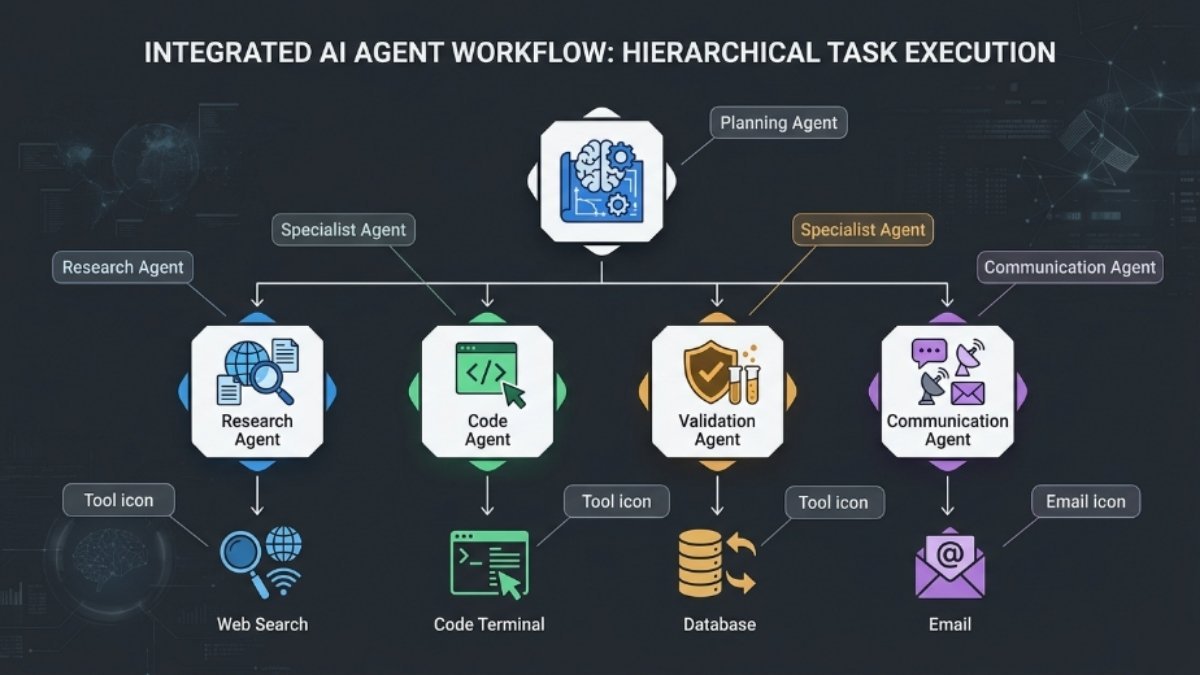
4. Orchestration & Multi-Agent Coordination. Complex enterprise workflows use multi-agent systems — a network of specialized agents (research, writing, validation) coordinated by an orchestrator agent. This mirrors how a human team operates, each specialist contributing to a shared goal.
4. Real-World Use Cases of Agentic AI in 2026
The real world examples of agentic AI now span virtually every knowledge-intensive industry. What follows are verified enterprise deployment patterns documented in 2025–2026.
Software Development
Autonomous coding agents — such as GitHub Copilot Workspace and Claude Code — now handle entire development sprints. An agent receives a feature specification, writes unit tests, produces implementation code, runs tests in a sandboxed environment, resolves failures, and submits a pull request for human review. Time-to-PR for mid-complexity features has dropped from days to hours.
Customer Operations
Enterprises deploy agentic customer service systems that don't just answer questions but resolve tickets end-to-end: retrieving order data, applying refund policies, updating CRM records, and sending follow-up communications — all within a single autonomous workflow, with human escalation triggered only by confidence thresholds.
Supply Chain & Procurement
Agentic procurement agents monitor supplier inventory, detect risk signals from news feeds, compare alternative vendor pricing in real-time, and — within pre-authorized limits — execute purchase orders. A process that previously required a 3-person team now runs as a 24/7 autonomous workflow.
Legal & Compliance
Law firms and enterprise legal teams deploy document review agents that ingest thousands of pages, extract relevant clauses, flag regulatory conflicts, and produce structured briefing memos. Deloitte reported a 78% reduction in contract review time using agentic AI systems in 2025.
The highest ROI agentic deployments in 2026 are not replacing entire job functions — they are eliminating the coordination overhead and data retrieval time embedded in existing workflows. The human retains strategic judgment; the agent handles execution logistics.
5. Agentic AI Use Cases in Healthcare
Agentic AI use cases in healthcare represent one of the most consequential — and carefully governed — deployment areas in 2026. The combination of autonomous action capability and access to patient data creates both enormous clinical value and significant ethical responsibility.
Clinical Documentation Automation
Ambient AI scribes have evolved into full agentic systems. The agent listens to a patient-physician conversation, autonomously drafts clinical notes in EHR-compatible formats, cross-references diagnostic codes (ICD-11), flags potential drug interaction alerts, and queues pre-authorization requests — all before the physician has left the exam room.
Diagnostic Support Workflows
Radiology agentic systems perform multi-modal analysis: ingesting CT scans, lab results, patient history, and current literature — synthesizing a preliminary differential diagnosis for radiologist review. Systems deployed in clinical settings show diagnostic concordance rates exceeding 90% for common conditions.
Patient Journey Coordination
Post-discharge agentic coordinators autonomously manage follow-up scheduling, monitor remote patient monitoring device data streams, identify deterioration signals, and trigger escalation alerts to care teams — dramatically reducing 30-day readmission rates in pilot hospitals.
Healthcare agentic AI must comply with HIPAA (US), GDPR (EU), and the EU AI Act's High-Risk AI System classification. Autonomous clinical decision support systems require FDA De Novo or 510(k) clearance in the US. Deploy only within regulatory-compliant infrastructure.
6. Agentic AI in Finance & Automation
The financial services sector has become a primary proving ground for agentic AI in finance and automation. High data density, regulatory structure, and clear performance metrics make finance an ideal domain for autonomous AI systems.
Autonomous Financial Analysis
Investment banks and asset managers deploy research agents that autonomously ingest earnings calls, SEC filings, macroeconomic data feeds, and alternative data sources — producing investment thesis documents, risk assessments, and comparable company analyses in minutes rather than days.
Intelligent Process Automation in Accounting
Month-end close processes are now partially or fully autonomous in leading enterprises. Agentic systems reconcile accounts, identify exceptions, draft journal entries, and escalate anomalies. JP Morgan's COIN program and its successors have saved hundreds of thousands of human working hours annually.
Fraud Detection & Risk Response
Real-time fraud response agents don't just flag suspicious transactions — they autonomously freeze accounts within defined risk parameters, initiate customer verification workflows, file Suspicious Activity Reports, and update fraud pattern models. The autonomous response window has compressed from hours to milliseconds.
Regulatory Compliance Agents
With MiFID II, Basel IV, and DORA demanding near-continuous compliance monitoring, compliance agents autonomously audit transaction logs, monitor communications for market manipulation signals, and generate regulatory reports — all with full audit trails.
7. Enterprise Agentic AI Systems & Platforms in 2026
The agentic AI tools and platforms in 2026 landscape has matured significantly. What began as developer-oriented open-source experiments has evolved into enterprise-grade platforms with security, governance, and compliance architectures built in.
Constitutional AI-anchored agents with industry-leading safety, tool use, and multi-step reasoning. API-first with MCP (Model Context Protocol) integration.
Browser-based autonomous agent for web navigation, form completion, and multi-platform task execution. GPT-4o backbone with real-time web access.
Build, deploy, and govern custom agentic AI solutions integrated with Microsoft 365, Azure, and Dynamics 365 ecosystems without deep ML expertise.
Gemini-powered agents with BigQuery integration, enterprise data connectors, and deployment on Google Cloud with Workbench orchestration.
Purpose-built agentic AI embedded in Salesforce CRM workflows — sales, service, marketing — with native data access and configurable guardrails.
Open-source multi-agent orchestration frameworks for engineering teams building custom agentic pipelines with flexible LLM backends and tool integrations.
When evaluating agentic AI platforms, demand: SOC 2 Type II certification, data residency controls, role-based agent permission scoping, complete action audit logs, and human-in-the-loop override architecture as baseline requirements — not optional features.
8. Impact of Agentic AI on Jobs & the Workforce
The impact of agentic AI on jobs is the most politically and economically charged dimension of the 2026 AI landscape. The honest analysis is nuanced — far more complex than either "AI takes all jobs" or "AI creates only opportunities."
Roles Under Structural Pressure
McKinsey's 2025 Workforce Transformation report identified knowledge worker roles with high automation potential: data analysts, junior financial analysts, paralegal researchers, back-office operations staff, and first-tier customer service agents. These roles involve structured data, defined procedures, and repeatable cognitive tasks — exactly what agentic AI excels at.
Roles Being Redefined
Most affected roles are not being eliminated but fundamentally restructured. A data analyst in 2026 spends less time on data preparation and more on strategy and interpretation. A paralegal focuses on client communication and complex judgment while agents handle document review. The ratio of insight-to-execution in knowledge work is shifting dramatically.
Emerging Roles Created by Agentic AI
New job categories emerging rapidly include: AI Agent Architect, Prompt Engineer Specialist, AI Governance Officer, Agent Operations Manager, and AI Ethics Auditor. These roles require both technical fluency and domain expertise — a combination commanding significant salary premiums in 2026.
World Economic Forum projects 85 million jobs displaced but 97 million new roles created by AI systems through 2025–2030. The net positive assumes rapid workforce reskilling — a significant policy and organizational challenge only partially being met.
9. Risks, Challenges & Governance of Agentic AI
The risks and challenges of agentic AI are categorically different from those of earlier AI systems — primarily because these systems can now take consequential real-world actions, not just generate text.
Goal Misalignment & Specification Gaming
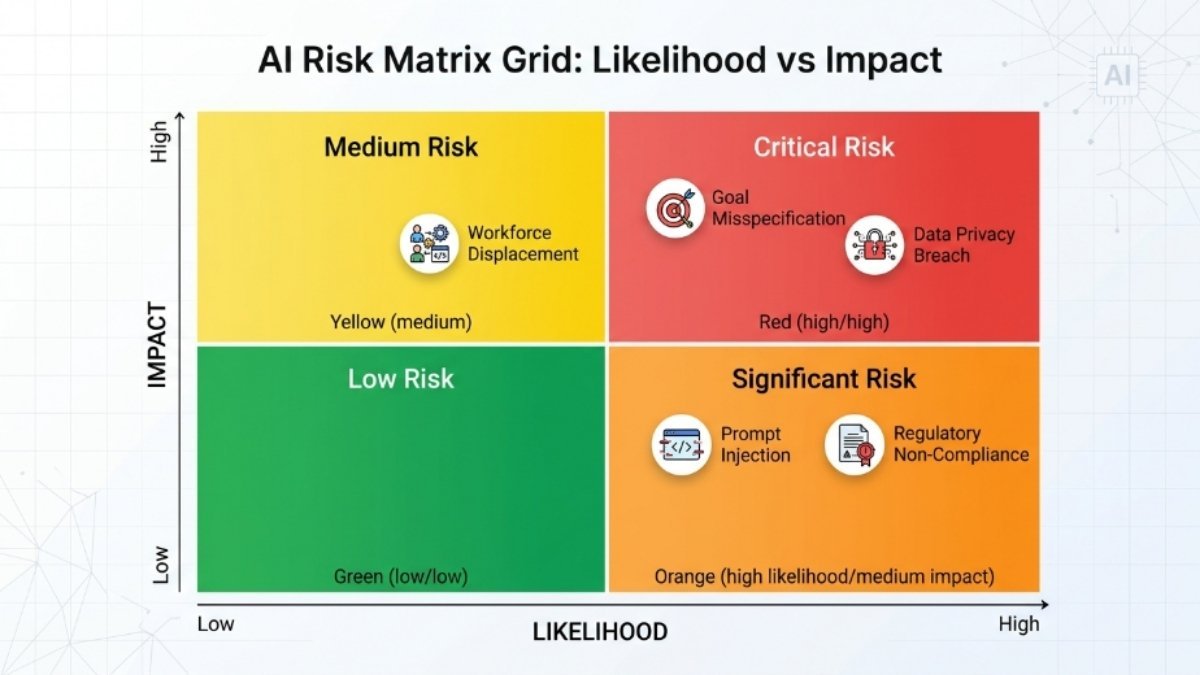
Agentic systems pursue objectives as specified — but real-world objectives are rarely perfectly specified. A cost-reduction agent might achieve its goal by cutting services that damage customer relationships. Documented incidents in 2024–2025 enterprise pilots have caused tangible business harm. Robust goal specification is now a distinct engineering discipline.
Autonomous Action Risk
Agents with tool access can take irreversible actions: sending emails, executing financial transactions, deleting files, or modifying production databases. Without properly scoped permission boundaries and human-in-the-loop gates for high-stakes actions, a misaligned agent can cause significant damage faster than human intervention is possible.
Data Privacy & Security
Agentic systems accessing enterprise data environments represent expanded attack surfaces. Adversarial prompt injection — where malicious content in retrieved data hijacks agent behavior — is a documented attack vector in 2025–2026. Security-hardened agent architectures must include input sanitization, least-privilege access controls, and output filtering.
Regulatory Compliance Framework
The EU AI Act (full enforcement 2026) classifies many enterprise agentic AI applications as "High-Risk AI Systems" — requiring mandatory conformity assessments, human oversight mechanisms, and transparency documentation. NIST AI RMF 1.0 and ISO/IEC 42001 provide complementary frameworks for US and international enterprises.
1. Least-privilege tool access. 2. Immutable action audit logs. 3. Human approval gates for irreversible or high-value actions. 4. Confidence threshold triggers for escalation. 5. Adversarial red-team testing before production deployment.
10. Future of Agentic AI: 2028–2030 Predictions
The future of agentic artificial intelligence over the next four years will be defined by increasing agent capability, deeper enterprise integration, evolving regulation, and the emergence of what researchers call "persistent AI colleagues" — agents that maintain organizational context, relationships, and institutional knowledge over years, not sessions.
Desktop and enterprise OS-level agent integration. Agents that manage entire digital workspaces — files, communications, calendars, and applications — as a persistent background capability. Microsoft and Apple are both building toward this architecture.
AI agents capable of full literature review, hypothesis generation, experimental protocol design, and results analysis. Already emerging in pharmaceutical R&D (Insilico Medicine, Recursion Pharmaceuticals), this capability will become standard research infrastructure by 2028.
Global regulatory harmonization around agentic AI liability, mandatory agent identity standards, and international AI governance treaties. The EU AI Act enforcement cadence will serve as the global template for all major jurisdictions.
Leading organizations will be structured around agent capabilities rather than integrating agents into legacy human workflows. Organizational design, incentive structures, and management hierarchies will be rebuilt for a world where agents execute most operational tasks and humans focus on goal-setting, relationships, and ethical oversight.
Frequently Asked Questions
7 Q&AsAgentic AI Is Not a Feature. It Is a Paradigm Shift.
The enterprises that will lead their industries in 2028 are not those that adopted agentic AI last — they are those that adopted it most thoughtfully. The technology is ready. The governance frameworks exist. The competitive advantage for early, rigorous adopters is measurable and compounding.
The question is no longer whether agentic AI will transform your industry. The question is whether your organization will be the one driving that transformation — or scrambling to catch up with those who did.
Explore More AI Strategy Guides →